Showing posts with label SOAP. Show all posts

Saturday, May 3, 2014

Fabros Farm: More than just a cacao farm, but a cacao forest


If  Fabros Farm accomplishes their goal  of planting more than 50 hectares of their forests with cacao, then it would become one if not the biggest cacao farm in Northern Luzon.

My introduction to the Fabros Farm is by way of a blog post - My own Bean-to-Bar chocolate making experience. Mr. Ansel Fabros, a medtech in Canada  got to read my blog and that started our exchange about cacao and chocolate.

He was also instrumental for the first cacao seminar  I attended that was offered for free by SOAP. There I met with his brothers Arnold and Ariel and some of their farm technicians. They brought and gave me several cacao pods (they call native variety) that I am now growing as seedlings.

He agreed on my request to visit their farm. So  past midnite, on a Holy Thursday (April 17, 2014) , with bus terminal jam packed with people, I joined the chaos of an  hour-long queue of commuters wanting to get a ride. Lucky enough to get a seat to Cabanatuan and then a van ride to Aurora, I arrived safe for the first time in the province.


I was received at the public market and was brought to the nursery of the Fabros Farm. I was told that there are around 50,000 seedlings ready to be transferred to the site. Most of the seedlings were grafted. And that they have a  70%  success rate of survival for their grafted seedlings. The grafted seedlings appear to be healthy, although some of the leaves shows sign of being eaten by insects. The farm uses insecticides to keep away insects from harming the seedlings.  In some parts, the nursery is a bit grassy, almost serving as shade to the seedlings.
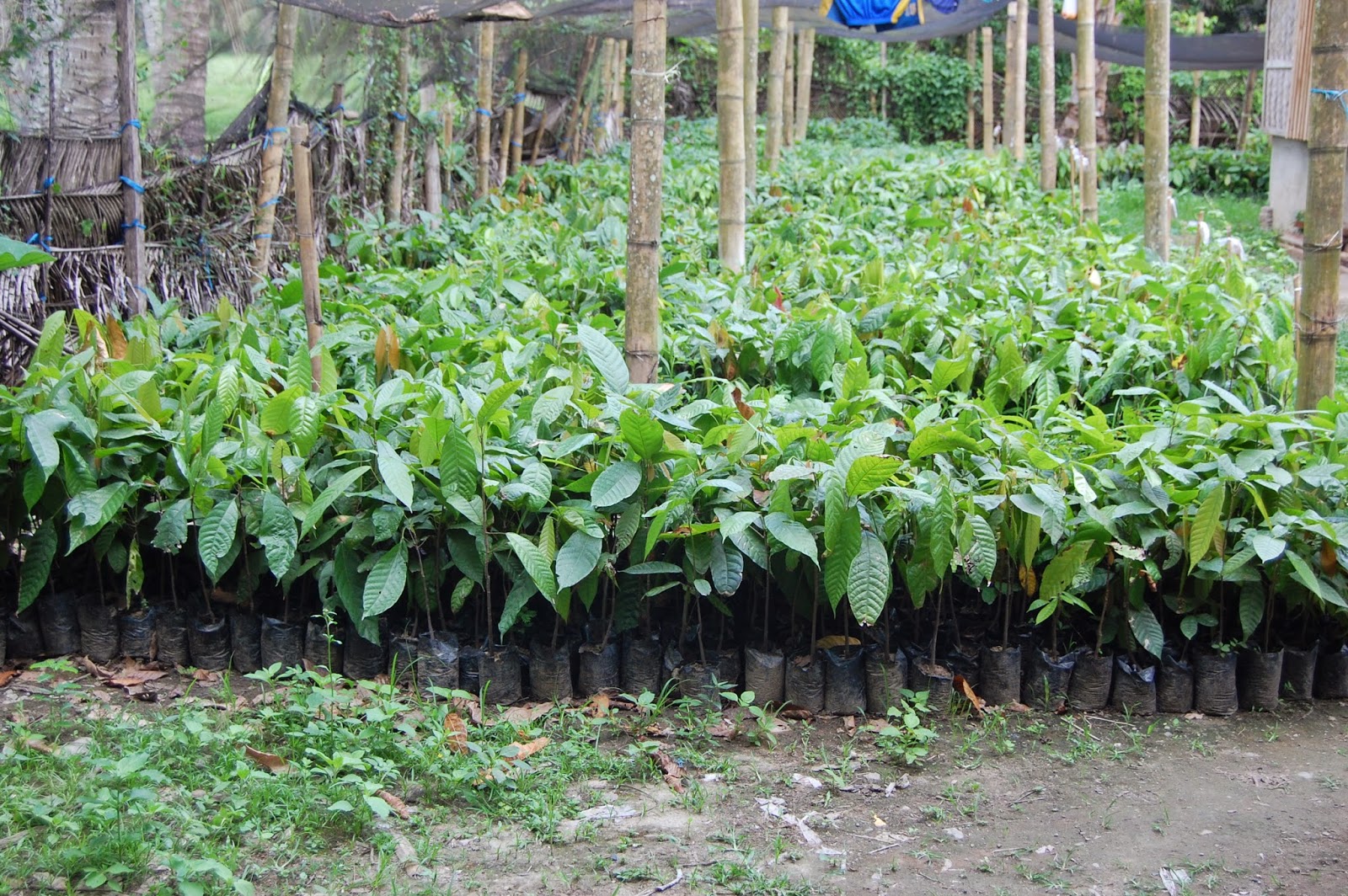
Aside from the seedlings located on the designated nursery plots, some of the seedlings were also under mango tree serving as shade. Although not prevalent, one of the problems identified is the presence of some fungus that seems to attack the roots of seedlings, making them rot. Solution to the problem is still being identified by the farm technician.

Cacao is endemic in the locality of Maria Aurora. In the neighborhood of Brgy. Diaat alone, cacao trees are grown in backyards. I was even shown of one resilient and abundantly fruiting cacao that is precariously thriving on a rocky ground on one end of the bridge just on top of its abutment. The tree appears like dangling on a cliff  above the rushing water. In other locations close by the river are some tall cacao trees that are intercropped with coconut and other trees. The trees are more than five years old and showing some of the  common cacao diseases.


Fabros Farm manages two separate locations for their cacao farm. One of the locations is called Agtedtedted more than 20 hectares and the other area is called Mumunsi, bigger area and several locations of more than 30 hectares. Both are forest areas that used to be logging sites where  remnants of cut trunks of huge and giant trees are on a state of decay. And the road system for 6x6 trucks remain passable.


Agtedteded is the pioneer farm. The location is about two kilometers away from the residential areas. Going to the area one has to traverse the long and winding river system.   Given also the condition of the bumpy roads, the seedlings from the nursery are allowed to recover for a week after they get transported to their new location.  After more than six months, almost half of the cleared area are now  replanted with cacao seedlings and other intercrops.  The distance they implement is 3.5m x 3.5m  for coconut and cacao intercrop  and  3m x 3m for cacao to cacao. The location has a spring that serves as a source of potable water for drinking and farm use.

Several farmers are tending the farm doing different farm duties. Some are clearing the farm for planting. Others are making charcoals from the fallen trees.  Others do the spraying  of a cocktail of foliar, fungicide, and  insecticide.  Spraying is one of the most challenging tasks given the hills get steep. Additional workers are being considered so as to cover spraying the wide expanse of the area.

Corn is used as shade and intercropped with cacao. Other vegetables are grown as well to serve as source of food for farmers who prefer to stay in the farm for the whole duration of the weekdays. Fruit trees and other trees (madre de kakaw) are also planted to serve as wind breakers.

Meanwhile the Mumunsi is the second location for the cacao  which is more expanse.  In an adjacent area are some old coffee trees which will be rehabilitated and soon planted with new coffee trees. Plots of coffee seedlings are also maintained in that location. There's a small cottage being built on top of the farm. And just below it is a swimming pool size pond to raise fresh water fishes as future source of food for farmers. Water source is from a spring. An almost kilometer length of water pipe was laid out from the spring to the cottage.


There are lots of work that still needs to be done in the area. Much of the cutting of trees and clearing are still on-going, although in the cleared area close by the cottage it is already planted with cacao seedlings. Transport of the cacao seedlings are being scheduled since the river gets swollen during rainy days and the rainy months is soon to come. Since the location is surrounded by forests, it gets cool in the late afternoon and sometimes showers at night.

Mr. Ansel Fabros is well aware of the challenges and concerns that they are faced with. But since he has invested most of his savings and support from angel investors, there's no more turning back.  Fabros Farm continues to invest in training their farm technicians. They are scheduled this summer for a 2-week cacao farming immersion with Mr. Peter Cruz in Davao.

So what was the inspiration for setting up the farm?  Below is a quote from Mr. Fabros:

When I went home in 2012, I saw many folks are jobless and just hanging around in our barangay (village). Also, I felt like that some of the amount we give as  investment for the family business back home are going nowhere. Some of our properties remain idle so I  started reading about High Value Crops and cacao got my attention. I did research on the internet and communicated with some  cacao players. And was frustrated BIG TIME with government's lack of reply to my queries. 
When I consulted a friend about cacao growing and  believes in the profitability of the project,  that's when Fabros Farm started. I have high hopes about this project. It is a very ambitious and daring  and I credit my brothers effort.  They are all absorbing the stress and pressure from me.  I hope someday, it will not only my family that will benefit  but the rest of the folks in our barangay. When the cacaos are fruiting and we have added income, it is my  plan to do "contract growing, intercropped with coconut" with or without government assistance.
 
Fabros Farm's pioneering spirit and noble goal of providing livelihood to the people of their barangay is laudable. Despite the many challenges and their lack of experience, the family enterprise make up for it with their collective effort and enthusiasm to see to it that their venture succeed. With its humongous size Fabros Farm is not just a cacao farm but a cacao forest full of potentials.

 More fotos here - https://www.facebook.com/media/set/?set=a.617984204937828.1073741830.365825456820372&type=3

Sunday, February 23, 2014

SOAP Holds Free Seminar on Cacao Production


I was able to attend this free seminar through my new online friend Emong Fabros who is in the process of building their Fabros Cacao Farm. I was able to get new cacao from Maria, Aurora courtesy of his brothers who also attended the seminar and brought the speaker Mr. Grover Rosit to their farm.


SOAP or Spread Organic Agriculture in the Philippines aims “to be your one stop hub for all your organic agriculture needs.  For everything, everyone and anything organic agriculture.  Let us link you to them....our advocacy.  I-Hub It!”. The group composed of individuals who advocate organic agriculture provides free seminar every 3rd Friday of the month on different topics on agriculture such as raw food, pro-biotic chicken, coco-sugar processing, etc. Last February 21 they  invited Mr. Grover Rosit of Rosit Cacao Farms of Baguio, Davao City for the Cacao Production Seminar.


Seminar participants came from as far as Cagayan and Aurora up North and Samar and Davao down South. The texts below are my notes of the lecture based on the power point presented and exchange among the participants. Refer to his presentation in PDF file below for the data and visuals. The following are highlights from his talk:


Sources -  http://www.mediafire.com/download/fpo83joa2185d7h/rosit+final.pptx


Pods Selection
Choose the biggest pod with the biggest seed. Have them soaked in water and discard those that float then allow them to germinate ( put in a warm and dark place) and then transfer to seedling bags. Once they are transferred to seedling bags keep the cover for moisture. Sun and air causes dehydration. Critical time to water seedlings is between 11AM-2PM.  UF18 is known to be drought and pest resistant. The pod size and seed most often is half the size of other varieties.


Soil Mixing
Use organic manure/fertilizer. If the soil is clay/sticky add rice hulk and saw dust. If it is sandy add loom and clay soil. 


Seedling bag
Use black 6x8 with holes seedling bag. 


Nursery
Seeds on its day 1 up to the 3rd week is the most critical period. It is better to have the seedlings on an elevated ground to prevent them from being flooded, especially in areas that might be prone to flooding.  
There should be a pathway/road where the seedlings could easily be transported say on a wheel barrow so as not to stress the seedling too much. There should also be a clean source of water supply. Dirty water will cause fungus. Seedlings should also be away from falling objects (example it is not advisable to create nursery underneath coconut trees). Better to arrange the seedlings in a way that it is easy to count for example 10 rows x 100 bags - for  a thousand seedlings.


Nursery Construction
Ideal place is a shaded area. Net could be used and other materials to prevent the seedlings from the acidity of rain and direct ultraviolet rays of the sun. It advisable to put matting underneath the seedlings so as to prevent the main root’s protrusion to the soil (cacao roots are sensitive). Create  knee deep canal to prevent the seedlings from being constantly soaked in water.  Cacao should be prevented from a water logged condition. If water does not dries up 2-3 days after a heavy rain then the place is considered water logged and this is not a good area for cacao to thrive.

Expose seedlings by just the mist of pesticide and fungicide and it is advisable to do it at 6PM since most insects (75%) are nocturnal. Should there be infestation do spraying at least twice a week. 


Grafting
Seedlings can be grafted after 3-4 months when the stem have grown into pencil size. Make sure to have the necessary tools for grafting. Those trees that are 30 years old could be considered senile and thus become less productive. Younger trees could produce as much as 200 pods. Cut undesirable trees and introduce new scion (bud stick) from a new and good variety. It will help improve the quality of fruit. Plastic cover for the grafted scion could be removed after 18/21 days. The plastic/cellophane tied cover will help to keep the moist to encourage faster budding. It should be covered from bottom to top (where it was joined). Make sure to have at least a leaf remaining from the root stock ( the leave/s will help with the photosynthesis). The size of the root stock should be the same size of the scion that will be introduced (a longer scion can break the root stock).

Those seedlings that are grafted on the field tend to be more resistant to pest and stress (wind, etc.) than those grafted at the nursery. Water these grafted seedlings at least every 2 days. In a row of seedlings those that gets easily dehydrated are those along the sides, so they need to be watered on a more regular basis.  

The importance of grafting is to make the tree to have a high fruiting capacity. It will also prevent the trees from growing tall. A dwarfed tree would be easier to wrap and put plastic on the  cacao pods to prevent it from being infested by insects (pod borer).

Check this videos:

(running time 8mins) 

(running time 6mins 30 secs)


Transplant of seedlings
Make sure than when transferring the seedling they get acclimatized in their new environment. Do not plant seedlings immediately on the prepared holes but have the seedling stay in their new surrounding for awhile before transplanting them (a day or two maybe?).  


Field planting
It is advisable to wait for a heavy rain before planting the seedling. That way water will have seeped through and will prevent organic fertilizers from being washed away once they are in the base of the hole. The advantage of organic fertilizer is that it is a lot more cooler to the seedlings than the inorganic fertilizer. 

Cacao thrive in different soil types for as long as it is a tropical place. Cacao is very adaptable in adjusting to any soil type. An exception, if the area is elevated or above 600 meters (e.g.Baguio City) from sea level although coconut may  thrive but not fruit then the same is true with cacao. 

A three year old cacao could produce as much as 4-6 kilos of beans. On a peak season harvest of cacao could reach as high as 5 to 8 times the regular harvest. It is observed that cacao can have their highest fruiting capacity in an open space/plantation type of set-up.

Ideal distance for cacao is 3 meters by 3 meters, in a rolling area it can be 3 meters by 2.5 meters.


Fronding cover
Sack could be used to protect the seedling - have it supported by 3 sticks on the sides. When spraying the sack could be sprayed upon and preventing the seedling from getting direct sprays.


Pruning
It is important to prune cacao so nutrients is not consumed by unnecessary branches. Champagne glass principle could be employed where the tree is not allowed to grow high but instead branches out on both sides (leave at least 3-4 branches at the lower part of the tree) are encouraged to grow so the middle resembles an open receptacle. The method also allows flowers to dry faster thus becoming fruits.   When the tree is about 8 months old pruning could be made already. In a long dry season, the sun stresses the tree in bearing more fruits on its next season of fruiting. 

Side grafting /budding could also be introduced to big and older trees. Make sure than when grafting insert cellophane into the wounded and joint scion to prevent water from entering and then wrap around the section with plastic tightly to have the graft heal and join together. Grafting helps rejuvenate an old tree.


Pollination
When the tree reached its 7th year in order to introduce a cross pollinator have another variety like BR25 grafted in the middle, which will be allowed to grow higher than the branches of the a UF 18 variety. As to the principle of gravity and air applies (which is the main pollination process for cacao), the pollens of BR25 would then fall down to the branches  and pollinates  UF18 flowers. When fruiting those fruits of BR 25 are easily identified from the UF18 should fruits/pods segregation (which is advisable) is applied. Once the fruits of the tree becomes smaller it is a sign of introducing new pollinator (on or after the 8th year of the tree).


Organic Fertilizer 
Use organic and readily available materials. Apply fertillizer on the base of the tree at least every 3 months in the first 2 years of the tree. The organic base for cacao for transplant could lasts for 1.5 years so fertilizing of the tree could be applied on the side of the tree.

Composition of an organic fertilizer
Chicken dung/manure   50%
plant waste/saw dust    30%
carbonize rice hull          10%
agri lime                             10%
IMO 1 (bacteria)             1 liter
IMO 2  (bacteria)            1 liter
Molasses                           5 kilo 

Liquid mix diluted in a drum of water (liquid solution) and applied to 2.5 tons of solid materials above. To fully mix apply one layer on top of  another solid material, one after the other and spraying it with the liquid solution to moisten mix. Cover for 15 days then mixed again. Then used a basal for the hole and apply as fertilizer on the base of the seedling/tree.


Spraying
It is needed to control fungus and insects. At least spray once every 3 months. On other occasion do spraying as a preventive maintenance of the orchard.


Wrapping pods
Will assure 100% that the fruit will not be attacked by pod borer. Also it will prevent them from exposure from chemicals when spraying is done. It will be a lot of cost savings on the part of the farmer. Pod rot is a common cacao disease.


Harvest
After 160 days cacao become mango size the pods can be harvested when they have turned yellowish. In a year there could be 3 fruiting harvest season.


Opportunities of Cacao Farming 
(please double check the items with that of the powerpoint presentation in PDF)
1 kg = 800 - 1000 seeds = P150.00
1 kg = 16 pods 
Scions sells at P3.00-4.00 ( since you prune you might as well sell)
Tablea - 1 kg = P300-400 pesos (process involved roasting and molding)


Financial Analysis for a 1 hectare of plantation 
(please double check the items with that of the powerpoint presentation in PDF)
3m x 3m of 1 has = 1,000 seedlings
= 60-100 pods/tree/year
=3-4 kilos of dried beans
= 4 k - 4 tons = 120/kilo = P 480,000/year/has
= less 15-20% overhead
= after 4-5 years earning is P 384,000/year

- on the succeeding year the plantation/farm will be self-sustaining
- P 25,000.00 maintenance cost
- P 80,000.00/has
- on the 7th year investment would have been gained back


Budget for 1 hectare (Davao rate) 
(please double check the items with that of the powerpoint presentation in PDF) 
Seedling = 1,200 x P25.00
Hauling - P 1.00/seed (every 2 km pick-up)
Plowing - tractor   P 5,000.00
                - carabao P 3,000.00
Total cost  = P 55,000 - 60,000/ has


Fermentation
As innovation for small farms, use sack that can be easily turned upside down so that the liquid gets equally distributed once the topmost part gets dried. US requires 8-10 days of fermentation but for European requires 10-12 days. The longer the cacao gets fermented the better and stronger aroma. But for tableya need not fermented for long at least 4-5 days, the longer it is fermented it turns sour when made into drink.


Related links:

A. Classics and Historical Readings about Cacao and Chocolate


B. Cacao Farming


flag counter

free counters

PinoyChocophile Magazine

add

Powered By Blogger